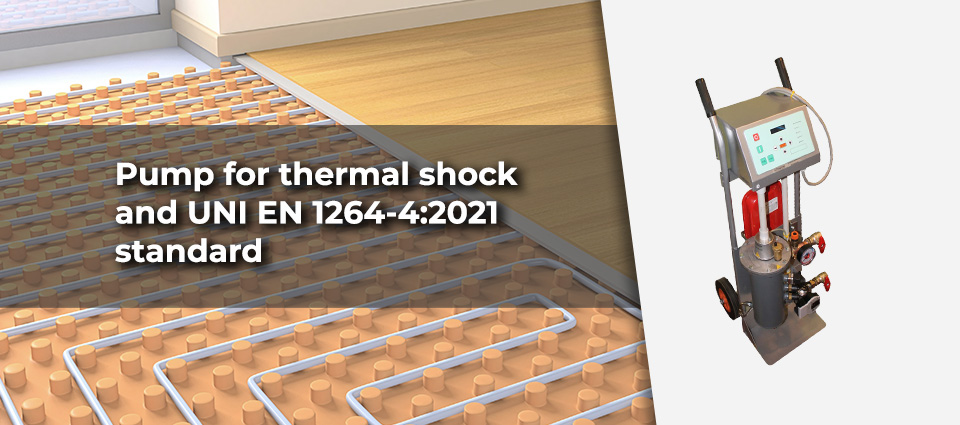
In recent years, more and more homes are built with an underfloor heating system, both for aesthetic reasons and for energy savings. This system is in fact able to transmit and spread heat homogeneously from the bottom up, in contrast to radiators that release heat in a more limited area. Although the initial cost is significant, the underfloor system can guarantee energy savings of 25% in one year. Moreover, it reduces the formation of dust harmful to health that is inevitably created with radiators or fan coils.
The radiant screed is one of the key elements in the efficiency of the underfloor heating system. It must comply with several requirements such as flatness, high mechanical strength, dimensional stability, and high thermal conductivity to ensure heat transmission. An underfloor heating system must be professionally installed to avoid unpleasant inconveniences after laying the flooring (both parquet and tiles), such as lifting or swelling due to excessive residual moisture.
The UNI EN 1264-4:2021 standard relating to the design and implementation requirements for floor, ceiling, and wall heating/cooling systems establishes that every underfloor heating system must undergo a thermal shock during the initial start-up phase to reproduce future thermal changes and ensure the stabilization of the screed. The process is regulated by the aforementioned standard and provides for a gradual increase in the temperature of the water circulating in the pipes to be maintained for several days. The purpose is to eliminate residual moisture, verify the correct construction of the screed, and avoid subsequent cracking during or after laying the floors.
To perform this operation, it is obviously necessary to use a heating system with a high degree of control, but it often happens that the building where the work is being carried out does not yet have a gas connection. This is where screed heater pumps come into play—electric boilers to be temporarily connected to the system. These pumps, thanks to a specific function, are able to circulate hot water in the underfloor system independently for several hours, according to the methods indicated by the regulations.
The New screed heating pump (SKU 70863) that Tecnogas offers you is portable system (weight 33 kg) ideal for hot testing of thermal systems. The thermal system is fully assembled and wired both electrically and hydraulically. The device is adjustable from 1 to 13 kW, it is equipped with circulation pump and prepared for the production of low and high temperature water. The tank has a maximum capacity of 5 l and the capacity of the expansion vessel is equal to 8 l . At the end, it is possible to export a report in which are summarized all steps of stabilization process of the pump. This report must be attached to technical documentation regarding the system and delivered to the customer as required by law EN UNI 1264-4.
If you would like more information on the new screed heater pump, click here.
Back to all newsDo you want more information?
Write to us!


 Megiston